Mechatronics / Mechanical Design
—
2025
Autonomous Warman Robot

My Role
Drop-off mechanism design, CAD, prototyping and mechatronic system integration.
Project Type
University Team Competition Project
University Subject
41059 Mechanical Design Fundamentals Studio 1
Tools & Technologies
SolidWorks · Arduino / C++ · SG90 Servo · Stepper Motors · Laser Cutting · 3D Printing
Team Context
Five-person multidisciplinary student team combining mechanical and mechatronics engineering skills.
Overview
The Warman project required the team to design and build an autonomous transport robot for a timed competition course. The robot needed to interact with a seesaw, collect balls, store them securely and release them into a designated deposit area while operating within strict size, time and reliability constraints.
The original approach attempted to travel over the seesaw, but physical evaluation showed that this created an unstable centre of gravity and a high risk of tipping. The team redesigned the robot to travel underneath the obstacle, which forced major changes to the chassis, storage system and pickup mechanism.
My Contribution
What I owned
My main responsibility was the ball storage and drop-off subsystem.
I developed several release concepts and compared their packaging, complexity and actuation requirements. The final solution used a compact rotating stopper actuated by an SG90 9 g servo. The stopper rotates approximately 90 degrees to open the storage channel and allow the balls to drop into the target zone.
I produced CAD for the subsystem, converted parts into manufacturable geometry, supported fabrication and integrated the servo mechanism with the Arduino control sequence. I also participated in full-system prototyping, testing, debugging and final mechanical adjustments.
The Challenge
The release mechanism had to retain the balls securely while the robot moved, release them quickly at the end of the run, fit inside a very limited volume and operate using a small actuator.
The entire competition run was limited to approximately 120 seconds, and most of that time was consumed by navigation, seesaw interaction and ball collection. The redesign to travel underneath the seesaw further reduced available vertical space.
Constraints
Approximately 120-second competition run.
Tight packaging and height restrictions.
Compact 9 g servo for the drop-off mechanism.
Drop-off had to be synchronised with Arduino control.
Balls could not jam or escape during movement.
Robot needed clearance beneath the seesaw.
Weight distribution affected traction and stability.
Fabrication had to use accessible student-workshop processes.
System & Design Development
How the system took shape
System Architecture
Navigation / drive motors
→ robot movement
Stepper-driven pickup ramp
→ lifts / guides balls into storage
Ball storage channel
→ retains balls during travel
SG90 servo + rotating stopper
→ releases balls into deposit zone
Arduino control program
→ coordinates motor, ramp and servo timing


Design Process
The project began with structured ideation and low-fidelity prototypes. My drop-off system progressed through four concepts:
1. Rotating servo stopper.
2. Lifting door.
3. Hinged rear door.
4. Cylindrical rubber-tensioned chamber.
The rotating stopper was selected because it offered compact packaging, simple geometry and rapid servo actuation.
The shift from travelling over the seesaw to travelling underneath it required the storage and release system to be redesigned around a lower overall profile.
High-fidelity parts were then produced using CAD, laser cutting and 3D-printed features. Hardware and software were integrated progressively before competition-style testing.
Key engineering decisions
Travel under the seesaw rather than over it
Testing showed that the original over-seesaw concept produced a high centre of gravity and a strong risk of tipping. The team redesigned the robot to pass underneath, improving stability but forcing a complete reconsideration of packaging and geometry.
Use a rotating servo stopper
A vertical door required too much clearance, while larger hinged mechanisms occupied valuable rear space. The rotating stopper fit beneath the storage channel and required only a short, fast servo movement.
Improve stability through weight distribution
The battery was moved toward the centre of the chassis to improve the centre of mass, and a bearing was added to the top of the robot to act as a rolling guide beneath the seesaw.
Testing & iteration
Balls could slip during pickup or jam during release, so the ramp and guiding geometry were refined. Grooves were added at controlled spacing to improve alignment.
Full-system testing revealed timing conflicts between motors and servos. The team modularised the code, used serial debugging and tuned delay intervals so actions occurred in the correct sequence.
Mechanical testing showed that off-centre battery placement reduced stability. Relocating the battery and adding the top guide bearing improved turning and low-clearance traversal.
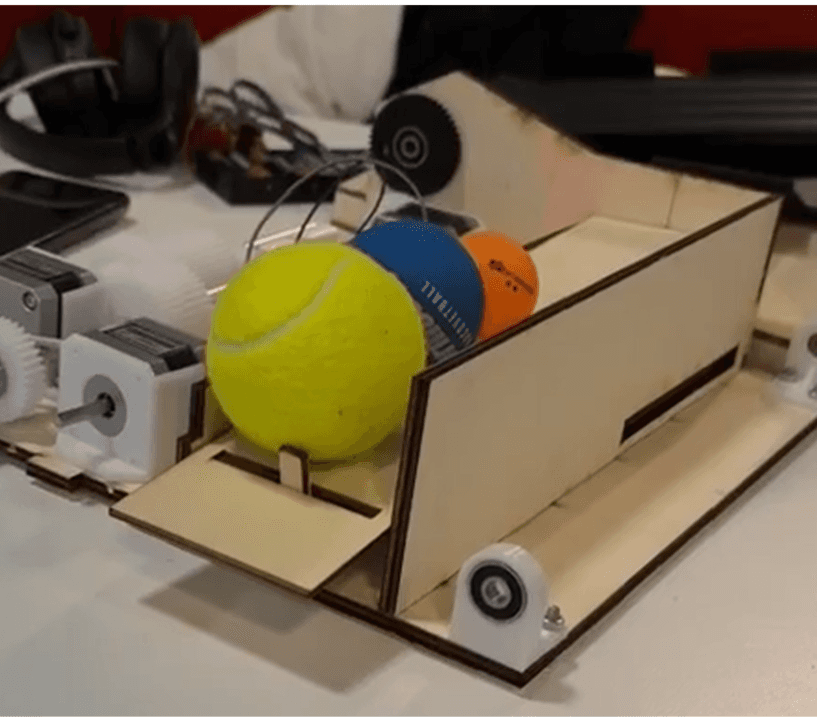

Final outcome
The project produced a functioning autonomous prototype combining mechanical design, fabrication and embedded control. My drop-off subsystem progressed from several concepts to an analysed, manufactured and integrated servo mechanism.
Results & Measurements
The final robot demonstrated obstacle interaction, ball collection, storage and servo-controlled release.
Across two final competition runs, the robot scored 15 points and 35 points for a total of 50 points. The ramp and drop-off concept functioned as intended, while traction and open-loop turning remained important sources of inconsistency.
Limitations
The final robot still experienced traction and open-loop turning inconsistencies. The control sequence relied heavily on calibrated timing rather than a fully closed-loop navigation architecture.
Additional sensing and feedback would improve positional accuracy and robustness.
Reflection
The project showed me how quickly small mechanical decisions can affect an entire mechatronic system. Changing the seesaw strategy altered the chassis, storage, pickup geometry and software sequence simultaneously.
It also reinforced the importance of testing hardware early. CAD was essential, but ball jamming, weight distribution, servo timing and friction only became obvious on the physical robot.
Project Links