Robotics / Software
—
2025
Safe Robotic Manipulation
My Role
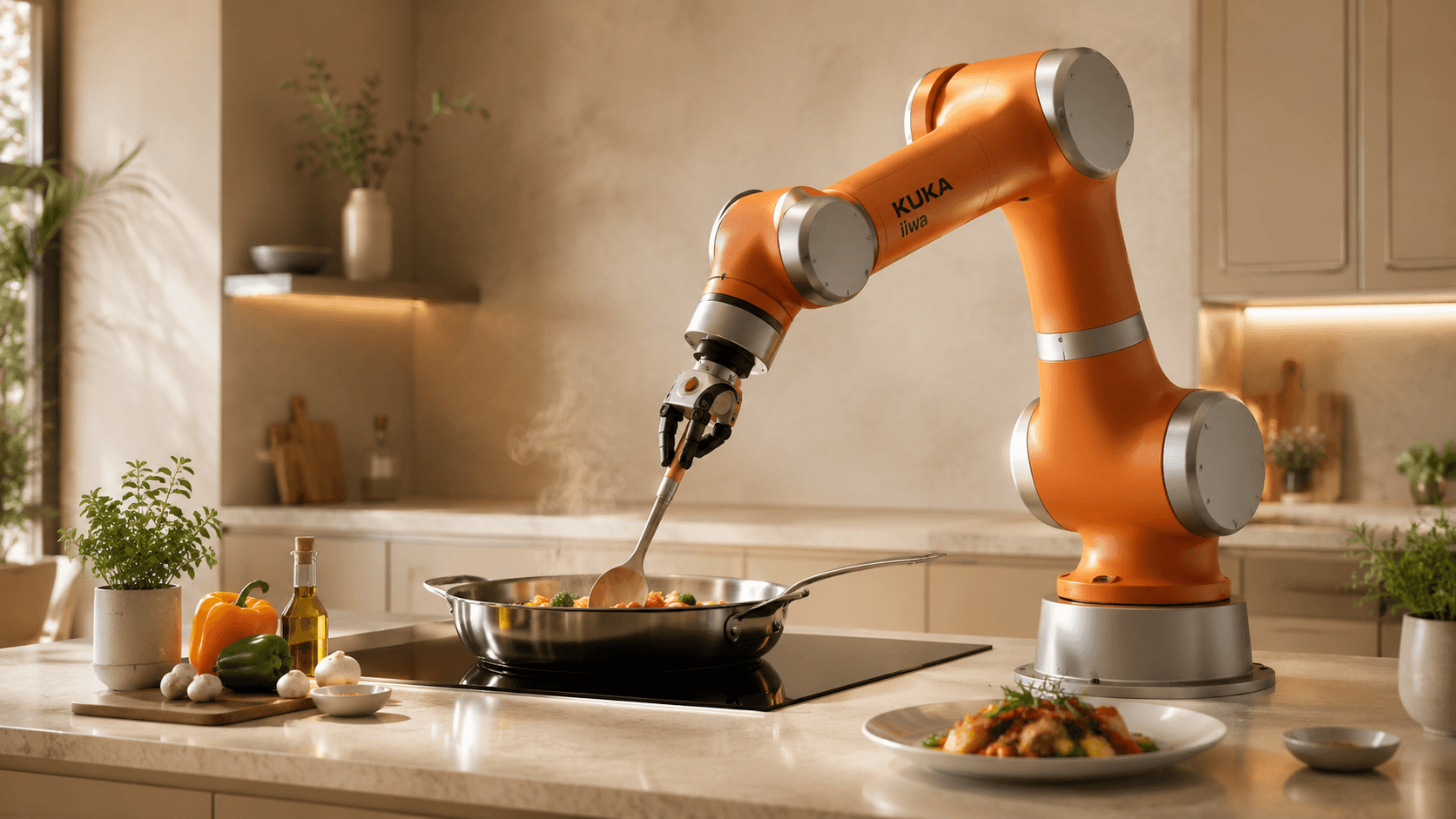
KUKA LBR iiwa 7 modelling, motion planning and robotic-system integration.
Project Type
University Team Project
University Subject
41013 Industrial Robotics
Tools & Technologies
Python · Robotics Toolbox · KUKA LBR iiwa 7 · Git · GitHub
Team Context
Collaborative multi-robot project in which several manipulators operated inside a shared simulated food-preparation environment.
Overview
The project explored how multiple robots could work together inside a collaborative food-preparation cell. Rather than treating each robot as an isolated mechanism, the workcell had to be considered as a complete system: robot models, coordinate frames, trajectories, task sequencing, collision risk, user control and emergency behaviour all interacted.
My focus was the KUKA LBR iiwa 7, a seven-degree-of-freedom collaborative manipulator. The robot was modelled in Python and integrated into the shared kitchen simulation so that it could perform controlled manipulation tasks while remaining compatible with the wider multi-robot system.
My Contribution
What I owned
I was responsible for developing and integrating the KUKA LBR iiwa 7 portion of the workcell. This involved constructing the robot model, working with its seven-joint kinematic chain and implementing controlled end-effector motion.
I worked with inverse kinematics, trajectory generation and resolved-motion-rate control to move the end effector through the workspace. I also contributed to collision-aware behaviour and the system-level safety workflow, including an emergency-stop state in which releasing the E-stop did not immediately restart the robots; a separate confirmation was required before motion resumed.
The project also required my robot to operate as part of a larger coordinated kitchen scenario rather than as a standalone demonstration.
The Challenge
Industrial robots are straightforward to move when the environment is empty and the task is isolated. The challenge becomes significantly harder when several manipulators share the same workspace and must interact with objects without colliding with each other, the environment or the task equipment.
The KUKA iiwa also has seven joints, which creates kinematic redundancy. This provides flexibility but means there can be multiple joint configurations for a single end-effector pose. The system therefore needed a repeatable way to generate useful, controlled motion while respecting joint behaviour and the shared workcell.
Safety also had to be treated as part of the system architecture rather than as a final add-on.
Constraints
Shared workspace containing multiple robot manipulators.
Seven-degree-of-freedom KUKA LBR iiwa kinematics.
Motion had to remain coordinated with the wider food-preparation sequence.
Collision risk between robots, objects and the simulated environment.
Emergency-stop behaviour needed to prevent unintended automatic restart.
Validation was primarily performed in simulation.
System & Design Development
How the system took shape
System Architecture
Task / target pose
→ inverse kinematics or RMRC
→ joint trajectory generation
→ KUKA iiwa joint motion
→ object manipulation
Safety logic operated alongside the motion system. Collision checking and emergency-stop states could interrupt normal operation, while the GUI provided a central interface for supervising the multi-robot workcell.


Design Process
Development began by modelling the KUKA LBR iiwa 7 and confirming that its joint structure, transformations and end-effector pose behaved correctly.
The next stage was controlled motion. Inverse kinematics and trajectory generation were used for point-to-point movements, while resolved-motion-rate control provided a way to control end-effector movement through Cartesian space. These functions were then integrated into the wider kitchen scenario.
The robot was subsequently connected to object-manipulation tasks, including interaction with a carrot within the simulated food-preparation workflow. Collision and safety behaviour were added so the system could respond appropriately when normal operation was interrupted.
Final integration focused on ensuring the KUKA code worked with the wider multi-robot GUI and system sequence.
Key engineering decisions
Use the KUKA iiwa’s redundancy as a motion-planning advantage
The seven-joint structure creates multiple possible configurations for many end-effector poses. Rather than treating the extra joint as a complication only, the system used kinematic planning methods that allowed the manipulator to move through the shared workspace while retaining flexibility in its configuration.
Separate emergency-stop release from motion restart
Simply releasing an emergency-stop condition should not automatically cause a robot to continue moving. The safety workflow therefore separated the E-stop release from the command to resume operation. A second deliberate confirmation was required before the system could continue.
Build the robot as part of the complete workcell
The KUKA model was not developed as an isolated animation. Motion functions, object manipulation, collision considerations and GUI control were integrated with the shared kitchen environment so that the robot behaved as one subsystem inside a larger automated process.
Testing & iteration
Testing was performed incrementally. Individual robot poses and trajectories were checked before integrating complete movement sequences. Kinematic behaviour was verified by comparing target end-effector motion with the resulting robot configuration.
The KUKA was then tested inside the shared kitchen environment, where trajectory behaviour, object interaction and potential collision conditions were more apparent. Safety logic was also tested through stop, release and resume states to confirm that the system did not resume motion immediately after the emergency stop was released.


Final outcome
The final workcell demonstrated how industrial robot control extends beyond simply commanding joint angles. Reliable behaviour depended on combining mathematical robot modelling with path planning, system coordination and safety logic.
Results & Measurements
The project produced an integrated simulated KUKA LBR iiwa 7 capable of planned movement and object manipulation within a collaborative multi-robot food-preparation workcell. The final system combined kinematic modelling, trajectory control, collision-aware behaviour, user interaction and emergency-stop logic.
Limitations
The project was primarily validated in simulation. A physical implementation would introduce additional uncertainty from calibration, sensor error, mechanical tolerances, controller timing and real collision dynamics.
The safety system should therefore be treated as a simulation-level engineering implementation rather than a certified industrial safety system.
Reflection
This project strengthened my understanding of how kinematics, software architecture and safety interact in robotics. The most important lesson was that a mathematically correct trajectory is only one part of a usable robotic system.
When robots operate in a shared environment, coordinate frames, sequencing, collision risk, user controls and safe recovery behaviour all become equally important.
Project Links