Infrastructure / Human-Centred Design
—
2024
Saibai Island Port Concept
My Role
Background research · Design option development · Detailed design · Design implementation · Budgeting
Project Type
EWB Challenge Team Project
University Subject
48230 Introduction to Engineering Projects
Tools & Technologies
Concept Development · Infrastructure Design · Budgeting · Prototyping · Stakeholder / Community Research
Team Context
Four-person EWB Challenge team working on Infrastructure Design Opportunity 3.1: Safe and Dignified Marine Access.
Overview
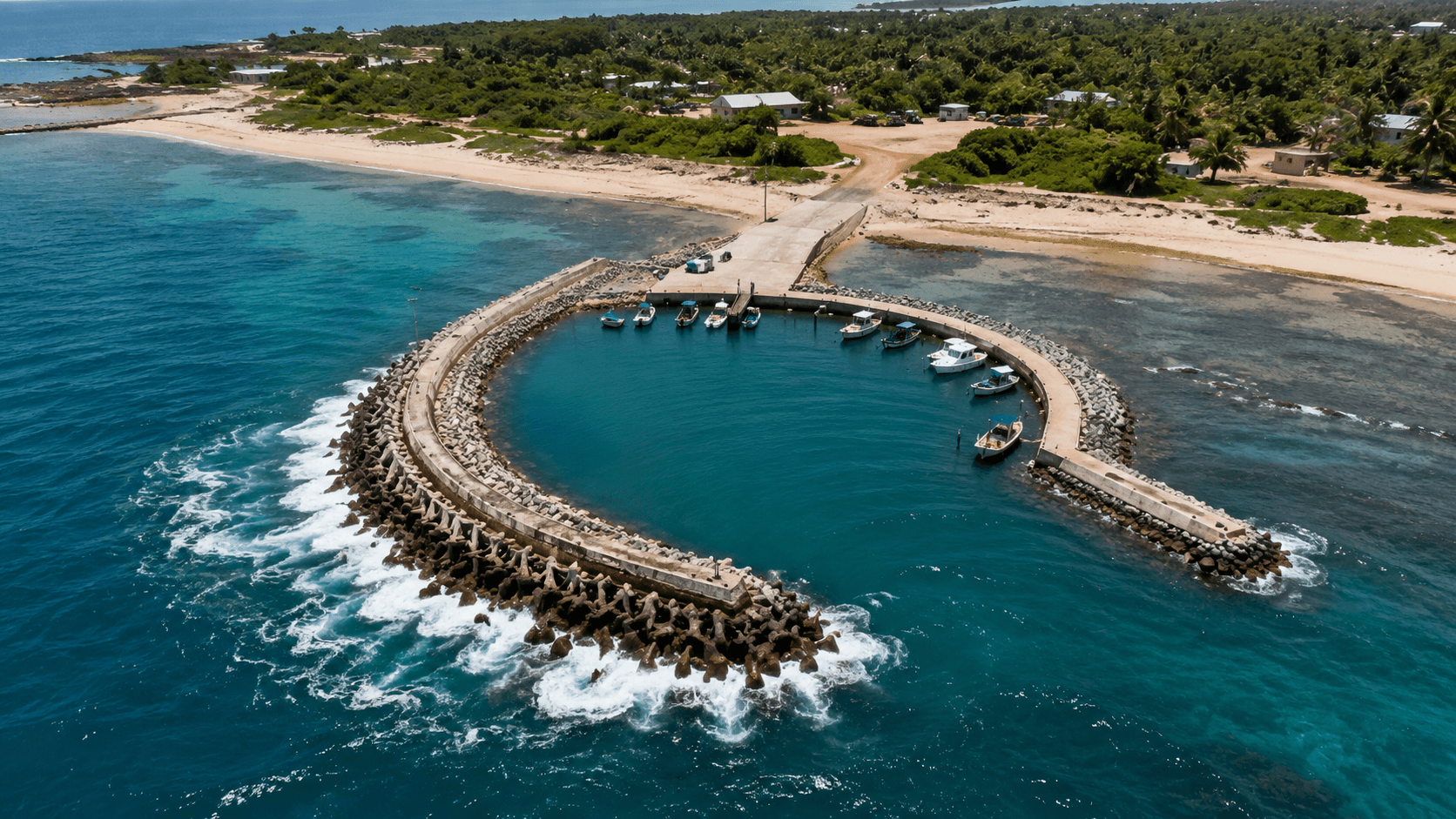
Saibai Island relies heavily on marine transport for access to goods, supplies and essential services. Rough seas, currents and changing tide levels can make water access difficult.
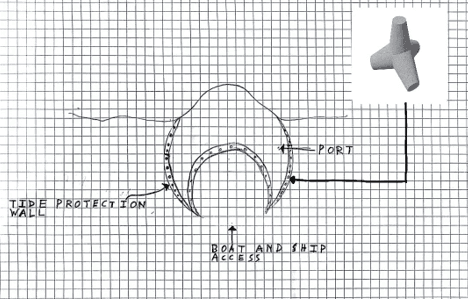
The project proposed a protected artificial bay around the marine-access area. The concept extends and reshapes the protective seawall so incoming waves are intercepted and dispersed before reaching the docking area and upgraded jetty.
My Contribution
What I owned
Role:
Background research.
Detailed design.
Design implementation.
Budgeting.
My work moved from understanding the problem and generating an early concept into developing how the selected infrastructure solution could be implemented and costed.
The Challenge
The solution had to consider changing tides, strong currents, long-term durability, maintenance, material supply, accessibility, environmental impact and the importance of marine transport.
Because Saibai is remote, implementation also had to consider the cost and logistics of transporting large quantities of material and specialist equipment.
Constraints
Design criteria:
Safe.
Accessible.
Durable.
Maintainable.
Environmentally sustainable.
Permanent / long functional life.
Implementation constraints:
Remote island location.
Imported material requirements.
Dredging.
Sand, rock, cement and concrete.
Changing tides and marine conditions.
Range of watercraft.
Community and cultural context.
The project recognised the Koeybuway and Moegibuway Peoples as the Traditional Owners of Saibai Island.
System & Design Development
How the system took shape
System Architecture
Incoming waves / currents
→ concave protective seawall / breakwater
→ wave energy intercepted and dispersed
→ calmer artificial-bay area
→ safer jetty and watercraft access
Implementation included dredging and material placement to extend / reinforce protective infrastructure.

Design Process
The team researched the Saibai context and translated the EWB brief into design criteria.
Several options were developed and compared against safety, accessibility, durability, maintainability, sustainability and permanence.
The selected artificial-bay concept was then developed through detailed planning. Implementation considered dredging, construction sequence, imported material, equipment and cost.
Key engineering decisions
Protect the access area rather than only modify the jetty
Improving the jetty alone would not remove wave and current conditions. The protected-bay concept addressed the surrounding marine environment first.
Use concave protective geometry
The seawall geometry was intended to intercept and disperse wave action and create a sheltered area for boats and passenger access.
Include implementation and budget in the design
The final concept included dredging, imported materials, specialised equipment and cost rather than stopping at a conceptual rendering.
Testing & iteration
The project used conceptual evaluation and prototyping rather than full-scale coastal testing.
Alternative concepts were compared against the criteria before the protected harbour was developed as the preferred direction. The team then refined detailed design, implementation and budget.
Final outcome
The project produced an early-stage infrastructure proposal connecting community need, environmental conditions, physical design and implementation planning.
Results & Measurements
The final proposal was an artificial protected bay designed to reduce rough-sea and current effects around the marine-access area.
The design combined a concave seawall / breakwater, dredging and improved jetty access, with estimated implementation cost of ~A$3.094 million.
Limitations
This was a student concept, not a construction-ready coastal engineering design.
Real implementation would require coastal modelling, bathymetric / geotechnical surveys, environmental approvals, community consultation through appropriate cultural protocols, structural design and professional review.
Reflection
This project changed my view of what counts as an engineering constraint. Location, culture, accessibility, transport logistics, maintenance and community priorities are part of the engineering system.
It was also early experience taking a broad design opportunity through concept development into detailed implementation and budgeting.
Project Links